AI roadmap: from strategy to measurable implementation
What makes a good AI roadmap, which phases it goes through, and how you, as an executive, can systematically plan the path from isolated AI experiments to results in production. Many mid-sized companies have already launched their first AI pilots, but there is often little substance behind them. The head of sales has ordered ChatGPT licenses, HR uses Copilot, IT knows nothing about it, and you have no idea whether all of this is worth €500 or €50,000 a year. What is usually missing between experiment and real business impact is a clearly defined AI roadmap: a structured plan that shows the effort and impact of each AI initiative and puts them in an actionable order.
AI roadmap: the key points
-
An AI roadmap is a strategic plan that defines which AI use cases a company implements, and in what order.
-
Before implementation, the prioritized use cases are assessed by effort and impact so that you can deploy limited resources where they count.
-
A good AI roadmap doesn’t stop at the analysis. It maps the entire path to production use, taking you from isolated pilots to an agent operating system.
What is an AI roadmap?
An AI roadmap is a structured action plan that defines which AI use cases a company implements, when, in what order, and with which resources. It translates the overarching AI strategy into specific steps and bridges the gap between the target vision and day-to-day business.
Unlike a general digitalization strategy, an AI roadmap focuses specifically on use cases where AI offers measurable leverage, for example:
- Automated processes in customer communication
- AI-assisted analysis in reporting
- Intelligent AI agents that independently handle recurring tasks in administration and the back office
Important:
An AI roadmap is not a static document. It is reviewed and adjusted regularly as new technologies, changing business goals, and lessons from ongoing projects come in.
AI roadmap vs. AI strategy: what is the difference?
The terms are often used interchangeably, but they mean different things.
→ The AI strategy describes the overarching vision for AI: What role should AI play in the company? Which business goals does it support? Which conditions apply to data protection, governance, and compliance?
→ The AI roadmap turns this strategy into a specific implementation plan. It answers the operational question: which use case comes first, with which team, in what time frame, and with what expected ROI?
“Without a strategy, an AI roadmap lacks direction. Without a roadmap, an AI strategy remains pure theory.”
With Lucid Labs, you get strategy, roadmap, and implementation from a single source: fast quick wins and lasting agent operating systems that deliver measurable results for mid-sized companies, such as up to 80% time savings through automated workflows.

Checklist · AI roadmap
Is your company ready for an AI roadmap?
Get an honest assessment in 2 minutes. Check off what applies to your company, and you will see right away how solid your starting position is and which next step makes sense.
- At least one process is repeated manually on a regular basis. Examples: writing quotes, sorting tickets every day, compiling reports every week.
- Management is behind AI. Backing at the C-level decides whether an AI pilot turns into a roadmap or fizzles out.
- There is digital data that can serve as a foundation. CRM, ERP, tickets, emails, documents: even unstructured data sources are a better starting point than knowledge that exists only in employees’ heads.
- Someone will drive the topic internally. Or there is at least a willingness to appoint someone. Without an internal owner, no AI project gets moving.
- You see the budget for a first AI pilot as an investment. A clearly scoped agent can usually be built for a low five-figure sum. The results from testing it in production then give you a solid basis for decisions on further investment.
Why do AI initiatives fail without a roadmap?
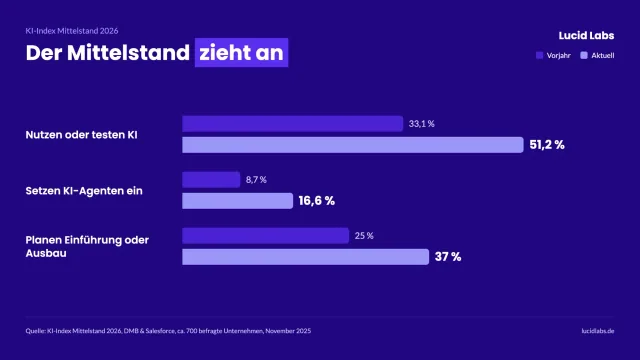
According to an AI study by maximal.digital, only 32% of small and medium-sized enterprises have a fully developed AI strategy. Only 19% have appointed a dedicated AI lead or set up an AI team.
The result: AI is used piecemeal, without end-to-end integration into processes and systems. In practice, the same patterns show up again and again.
Pilots that lead nowhere
Individual teams test AI tools on their own initiative. Microsoft Copilot gets rolled out, and a few departments use ChatGPT. But without an overarching plan, these initiatives remain isolated. They lack a connection to the core business and to the processes where AI could actually make a difference.
Lack of prioritization
When 20 possible use cases are on the table at once, often none of them gets done properly. Without a systematic assessment of effort and business impact, resources are spread across too many workstreams, and the impact fizzles out.
No measurable ROI
Without defined KPIs and a before-and-after comparison, there is no way to prove whether an AI initiative justifies its effort. The question “What does this actually do for us?” goes unanswered, which undermines acceptance among management and employees alike.
Internal resistance and a lack of enablement
A RAND study shows that more than 80% of all AI projects fail. The main causes it identifies range from an unclear problem definition and missing data foundations to organizational hurdles during rollout. If employees don’t understand why and how an AI tool is being used, they use it only superficially or actively avoid it.
A good AI roadmap addresses all of these points: it sets priorities, defines responsibilities, and maps out the path from idea to production use.
The 4 phases of a successful AI roadmap
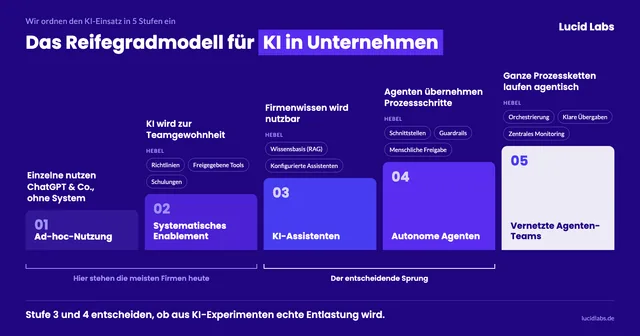
A practical AI roadmap for mid-sized companies goes through 4 phases. Each phase builds on the previous one and delivers a specific result that makes the next phase possible.
Phase 1: Assess the status quo and define goals
Before you identify use cases, you need clarity about your starting point. This phase answers 3 questions:
-
Where does the company stand today? This covers its AI maturity, the existing system landscape (ERP, CRM, DMS), data availability, and the team’s experience with AI so far.
-
Which business goals should AI initiatives support? AI is not an end in itself. The roadmap has to be aligned with specific business goals: shorter lead times, higher customer satisfaction, fewer manual processing steps, or resolved capacity bottlenecks.
-
What constraints apply? Data protection requirements (GDPR), regulatory requirements (AI Act), IT security policies, and budget ranges are documented so that the roadmap stays realistic.
The outcome of this phase: a documented status quo and a clear target vision as the basis for identifying use cases.
From our experience:
The assessment often uncovers blind spots: many companies underestimate how far along they already are. Excel macros, rule-based email forwarding, or automated invoice checks are usually early forerunners of AI processes. If you don’t take stock of these, you build your roadmap on the wrong baseline.
Phase 2: Identify and prioritize use cases
This phase is about filtering out, from the many possible use cases, the ones with the greatest leverage. That requires involving the business units: in interviews and workshops with process owners, you identify the workflows that are the most time-consuming, the most error-prone, and the most relevant to value creation. The collected use cases are then assessed systematically.
Common criteria for identification and prioritization:
- Expected business impact (time savings, cost reduction, quality improvement)
- Technical feasibility (data availability, system integration)
- Organizational feasibility (acceptance within the team, responsibilities)
- Compliance requirements
The outcome: a prioritized list of 10 to 15 use cases, sorted into quick wins (high impact, low effort) and strategic projects (high impact, higher effort). This prioritization keeps resources from flowing into prestige projects while obvious efficiency gains go untapped.
From our experience:
The real problem is rarely identifying AI use cases; it is prioritizing them. The head of sales wants to automate the sales forecast, accounting wants to process incoming invoices, and the CEO saw an AI chatbot at a trade fair and wants one too. Without transparent scoring (for example, with an effort-impact matrix), the decision quickly becomes political rather than rational.
Phase 3: Run a pilot and prove the concept
The roadmap starts with one or two use cases that have a high probability of success. The pilot is not only a technical proof; it also provides organizational proof that AI works in our processes, with our data, for our employees.
A good AI pilot has clear success criteria (KPIs), a defined time frame, and a before-and-after comparison. That makes it possible to quantify the impact and lay the groundwork for scaling. Just as important, the pilot involves the employees who will later work with the solution. Enablement and training don’t start after go-live; they start in the pilot phase.
Example:
A mid-sized healthcare company chose the automatic classification of service inquiries as its first pilot. The advantage of this use case: a limited scope, measurable in processing time per ticket.
After 4 weeks, the agent was in production, and the average processing time had dropped by 40%. What made the difference was not just the technology but the fact that the support team helped shape the pilot from the very beginning. A solid basis for decisions on further investment.
Phase 4: Scale and optimize continuously
After a successful pilot, the rollout extends to further use cases in line with the prioritization from phase 2. The AI roadmap becomes an ongoing management tool: new use cases are added, existing solutions are optimized, and KPI trends are monitored continuously.
This is also the phase that separates good AI partners from the rest. A typical obstacle: the consultancy that created the roadmap hands over to a development team that doesn’t know the context. Every handover costs 4 to 6 weeks, and often all of the company’s momentum.
That is why Lucid Labs offers consulting and implementation from a single source. We know your prerequisites and goals in detail, update your roadmap regularly, grow your agent operating system, and build lasting AI expertise in your organization.
From roadmap to AI in production: the execution gap
Most AI roadmaps don’t fail at the analysis stage but at implementation. The strategy is in place and the use cases are prioritized, but then one of three things happens:
- The internal team doesn’t have the capacity,
- implementation drags on for months, or
- the solution remains a prototype without a connection to real systems.
This pattern has a name: the execution gap. It opens up when consulting and implementation are treated as separate things. An external team analyzes and recommends, but implementation is left to the client or yet another service provider. Every handover costs time, context, and momentum.
For mid-sized companies, this break is particularly critical. IT resources are limited, a dedicated AI team is rare, and day-to-day business leaves little room for special projects.
The key is to treat roadmap and implementation as one continuous process. Use cases are not just identified and prioritized but turned directly into production-ready AI solutions, ideally by the same team that did the analysis. This is where Lucid Labs comes in.
AI roadmap with Lucid Labs: strategy and implementation from a single source
Lucid Labs supports mid-sized companies from identifying the first use case to running AI agents in production. Our approach closes the execution gap because analysis, roadmap, and implementation come from a single source.
Why Lucid Labs?
Lucid Labs is not a traditional consultancy that delivers strategy papers and then moves on to the next client. Our team consists of experienced developers, product managers, and AI specialists who build what they recommend.
Three principles set our approach apart from traditional AI consultancies:
-
No vendor lock-in: Solutions run on open architectures with EU hosting. IT can sign off easily because access, roles, and logging are managed transparently.
-
Implementation in weeks, not months: Your first AI agent can be live in production within 3 to 6 weeks, depending on the scope. The ROI is measured through a specific before-and-after comparison.
-
An extensible agent operating system: We design every AI agent so that it can be integrated into a connected team of specialized agents. The roadmap doesn’t end with a pilot; it ultimately leads to a holistic agent operating system.
What does working together look like?
Depending on your starting point, Lucid Labs offers different ways to get started:
For quick proof, the Agent Quick Start is the right fit: within 3 weeks, we build a working prototype with real data, including an impact assessment. Fixed price: €3,200.
For teams that want to gain clarity together, the process starts with an AI Kickoff: an executive workshop with systematic use case development, an assessment of effort and benefit, and a documented action plan with the 10 to 15 most effective automation opportunities. From €6,000.
If you want strategy and your first production agent in one package, choose the AI Springboard: from the workshop and in-depth interviews with process owners to your first AI agent in production in about 3–6 weeks, including a prioritized roadmap for the remaining use cases.
For building out an entire agent operating system, there is the AI Manufactory: a dedicated AI team that delivers a new production agent every 4 to 8 weeks, optimizes existing agents, and develops AI champions in your business units. We set the scope based on the workshop and roadmap; it is cancelable monthly after a 2-month ramp-up phase.
Clients such as Siemens Energy, Deutsche Bahn, OPED, and Ableton show that the approach works across industries.
FAQ
How much does it cost to create an AI roadmap?
The cost depends on the scope. At Lucid Labs, an AI Kickoff with a prioritized action plan starts at €6,000. If you want to combine the roadmap with your first AI agent in production, you can implement the first agents with Lucid Labs right afterward.
How long does it take for an AI roadmap to deliver first results?
A first working prototype with real company data can be ready in three weeks. An AI agent running live in production is realistic within four to eight weeks, depending on the use case. A realistic overall roadmap for mid-sized companies covers 6–12 months.
What happens if the pilot doesn’t deliver the hoped-for impact?
Then you have still gained something: clarity. Each of our AI pilots comes with predefined KPIs and a before-and-after comparison. If the impact falls short of expectations, you know exactly why and can approach the next use case in a more targeted way. In practice, this rarely happens, because we deliberately prioritize your pilots by their probability of success.
How do I get my team to actually use the AI solution?
Adoption is decided well before go-live. That is why we involve the employees who will later work with the solution as early as the pilot phase. We also develop AI champions in the business units: people who bring their teams along and relay feedback.
Do I need in-house AI expertise to implement a roadmap?
No. A good implementation partner brings the technical expertise and at the same time makes sure that AI skills are built up within the company. Lucid Labs works with AI champions in the business units so that the knowledge stays anchored in-house for the long term.
How do I make sure my AI roadmap complies with the GDPR and the AI Act?
Compliance requirements are captured in phase 1 of the roadmap and feed into the assessment of every use case. Lucid Labs relies on EU hosting, transparent data processing, and role-based access control, so that your IT department can follow and approve everything.