Multi-agent systems: how AI agents work as a team to solve complex tasks
Many companies find that isolated AI solutions hit their limits as soon as a process involves several steps, different data sources, or specialist expertise. Multi-agent systems solve this with a clear division of labor: several autonomous AI agents each handle a specialized subtask and together orchestrate complex workflows. But what exactly are multi-agent systems, how do they work, and when do they pay off for your company? This guide explains.
Multi-agent systems: key takeaways
- A multi-agent system (MAS) consists of several autonomous AI agents that take on specialized tasks and work together in a coordinated way.
- MAS offer measurable advantages over single AI agents: better scalability, higher performance through specialization, more resilience when something fails, and parallel processing of complex tasks.
- For mid-sized companies, practical applications of multi-agent systems range from customer service automation and content creation to supply chain management and software development.
- Implementation requires careful orchestration, but it pays off for complex, multi-step processes with measurable ROI.
What is a multi-agent system? Definition and core concept
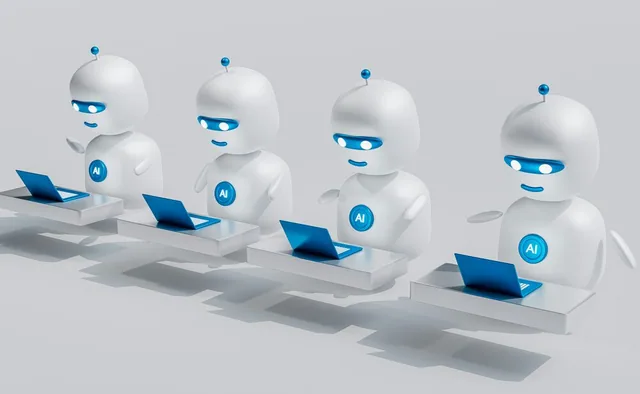
A multi-agent system (MAS) is an AI system in which several autonomous AI agents interact with each other and with their environment to solve complex tasks together. Each agent has specialized capabilities, makes its own decisions, and communicates with other agents to reach a shared goal.
The key difference from a single AI agent: instead of one generalist, several specialists work together. Here is a practical example:
→ In a support ticket system, agent A classifies incoming requests,
→ agent B searches the knowledge base,
→ agent C checks the customer history in the CRM, and
→ agent D drafts a proposed solution.
Modern agents can understand natural language, interpret complex instructions, and work flexibly with tools. For the first time, this makes multi-agent systems practical for production use at mid-sized companies.

Single agent vs. multi-agent system: the difference
The central question is when a single AI agent is enough and when you need several. Here is an overview:
Single agents are suited to clearly defined, linear tasks.
→ Example: an agent answers customer inquiries based on a knowledge base. The process is straightforward and does not require parallel processing.
Multi-agent systems become relevant for:
- complex workflows that span several systems
- different specialist areas or data sources
- tasks where parallel processing increases efficiency
- processes that need specialization to reach high quality
→ Example: a due diligence review requires a financial analysis, a contract review, and a technical assessment. Three specialized AI agents work in parallel instead of one agent working through everything in sequence. This saves time and improves the quality of the output.
Another advantage of MAS is resilience. If one agent fails, the others keep working. In a single-agent system, the entire process comes to a halt.
In practice, we recommend this approach: start with a single agent for clearly defined tasks. Once that agent has to handle too many different tasks, or your workflows require several steps across system boundaries, move to a multi-agent approach.
| Single agent | Multi-agent system | |
|---|---|---|
| Use case | Simple, linear tasks | Multi-step workflows |
| Data sources | One system | Several systems |
| Processing | Sequential | Can run in parallel |
| Specialization | Generalist | Multiple specialists |
| Resilience | Single point of failure | Redundancy |
How do multi-agent systems work?
Multi-agent systems rest on 3 principles: communication, coordination, and orchestration.
- Communication: Agents exchange messages to share information and delegate tasks. In modern LLM-based systems, this happens through structured messages or natural language.
- Coordination: There are 2 approaches. With central coordination, a master agent assigns the tasks. With decentralized coordination, the agents negotiate among themselves.
- Workflow patterns: sequential (one after the other), parallel (at the same time), hierarchical (across several levels), or collaborative (joint decisions).
Frameworks such as LangGraph, CrewAI, or the OpenAI Agents SDK handle the technical implementation of a MAS. They abstract away the complexity and provide standard mechanisms for message passing, orchestration, and tool integration.
Info: centralized vs. decentralized architectures in multi-agent systems
→ Centralized architectures (one master agent controls the other agents) are easier to implement and suit predictable workflows.
→ Decentralized architectures (the AI agents all communicate independently, as equals) are more resilient and scalable, but technically more complex.
→ Many systems combine both: a central orchestrator delegates to agent teams that collaborate internally in a decentralized way.
The 5 most important benefits of multi-agent systems
1. Specialization instead of compromise
Each agent focuses on what it does best. A finance agent understands balance sheets better than a generalist, and a legal agent interprets contracts more precisely. The result is higher quality and consistency.
2. Parallel processing
Several agents work on subtasks at the same time instead of working through everything in sequence. In content production, for example, a research agent, a writing agent, and a fact-checking agent work in parallel. This saves time.
3. Scalability
You add new capabilities by adding new agents, without retraining the system as a whole. Suddenly need support for a new supplier? Add a specialized agent.
4. Resilience
If one agent fails, others take over or the system keeps running with reduced functionality. In a single-agent system, by contrast, everything stops at once.
5. Cost efficiency
Because the work is divided, you can choose the right model for each subtask. A lean, inexpensive model handles simple tasks such as classification or data extraction, while you leave complex reasoning or text generation to a more powerful one. That way, you only pay for computing power where you actually need it. In practice, this kind of targeted model routing cuts token costs by 30–70% compared with a setup in which a single top-tier model handles everything.
Did you know?
Microsoft Research shows in benchmarks that multi-agent systems clearly outperform single-agent approaches on complex tasks when both use the same underlying model.
Multi-agent systems in practice: 7 use cases
The following 7 use cases show how specialized AI agents work together across different parts of a company, from HR, sales, and compliance to facility management. They all have one thing in common: repetitive processes are automated, turnaround times drop sharply, and employees are freed up for work that creates value.
1. HR & recruiting
A screening agent analyzes incoming applications, while a matching agent compares them with the relevant job requirements. A communication agent handles the first round of correspondence with applicants, and a scheduling agent coordinates the interviews. This allows companies to cut time-to-hire by 40–60% while improving the candidate experience.
2. Sales & lead qualification
A research agent enriches incoming leads with company and industry data. A scoring agent assesses the likelihood of a purchase, an outreach agent personalizes the approach, and a CRM agent enters all the information into the system in a structured way. The result: sales teams work only with pre-qualified opportunities.
3. Compliance & regulation
Monitoring agents continuously scan for new regulations and legislative changes. Analysis agents check how relevant they are for the company, mapping agents match them against existing processes, and reporting agents produce specific recommendations for action. This is especially relevant for heavily regulated industries such as pharma, energy, and financial services.
4. Procurement & supplier management
Market analysis agents compare prices and terms from different suppliers. Negotiation agents use this information to develop optimal bid strategies, contract agents review terms and conditions and individual clauses, and performance agents assess how reliable each supplier is. With well-founded negotiating positions, procurement teams achieve savings of 15–25%.
5. Knowledge management & onboarding
A capture agent structures existing company knowledge from documents, meetings, and chat tools. An update agent keeps the knowledge base current, a learning agent creates personalized onboarding paths, and a Q&A agent answers employee questions in context. As a result, new employees become productive in days instead of months.
6. Project management & reporting
Status agents collect updates from tools such as Jira, Confluence, and email. Risk agents spot delays early, report agents generate stakeholder updates, and resource agents optimize team utilization. Project leads can spend their time on decisions instead of on collecting data.
7. Real estate and facility management
Tenant agents handle inquiries automatically, maintenance agents coordinate tradespeople, billing agents prepare service charge statements, and market agents analyze current rent trends. The administrative workload falls by 50% or more.
Common challenges with MAS
Multi-agent systems do not run themselves. These are the 3 main challenges that come up again and again when teams set up a MAS:
-
Coordination effort: The more agents, the more complex the orchestration. Frameworks help, but you need clear workflows and monitoring.
-
Cost control: More agents mean more token consumption and more API calls to LLM providers. With cloud-based systems, costs can rise quickly, so set clear budgets and limits.
-
Security: LLM-based agents can hallucinate or behave unexpectedly. Put guardrails, human-in-the-loop mechanisms, and thorough testing in place.
Did you know?
The research firm Gartner predicts that over 40% of agentic AI projects will be canceled by the end of 2027, mainly because of unclear ROI and inadequate risk controls (source: Gartner). The key to success: start small, choose measurable use cases, and scale step by step.
With Lucid Labs, you have a partner who understands the potential and best practices of AI solutions as well as their challenges and limits. Do you want to set up an AI project at your mid-sized company that lasts and actually runs in production?
Then get in touch today, free and with no commitment. We will be glad to advise you on an AI solution tailored to your company.
Tools & frameworks: the technology stack
Several mature frameworks are available for building multi-agent systems:
LangGraph – workflow-oriented orchestration
Part of the LangChain ecosystem. LangGraph is particularly well suited to complex, stateful processes with clearly defined steps. It is the right choice when agents need to run through structured workflows.
CrewAI – role-based team orchestration
Agents are given defined roles, as in a real team, and work on tasks together. CrewAI is especially beginner-friendly and makes it quick to get started with multi-agent setups.
AG2 (formerly AutoGen) – conversation-based agents
AG2 is the community fork of Microsoft’s former “AutoGen” project and has been developed independently since late 2024. Its focus remains on conversation-based collaboration between agents and humans (human in the loop). AG2 now also supports framework interoperability and the open A2A protocol, so agents from different platforms can work together in one team.
OpenAI Agents SDK – minimalist and production-ready
Released in March 2025 as the successor to the experimental Swarm framework, the Agents SDK offers a lean set of primitives: Agents, Handoffs (delegation between agents), Tools, and Guardrails. It is provider-agnostic and integrates natively with the Model Context Protocol (MCP). It is the right choice for fast development and production-ready multi-agent workflows.
| Framework | Strengths | Best for | Learning curve |
|---|---|---|---|
| LangGraph | Workflow-oriented, stateful | Complex business processes | Medium |
| CrewAI | Role-based, team-oriented | Collaborative workflows | Low |
| AutoGen | Conversational, human in the loop, A2A protocol | Prototyping, cross-platform agents | Low |
| OpenAI Agents SDK | Lean, production-ready, MCP-native | Fast development, handoff workflows | Low |
Building multi-agent systems for production with Lucid Labs
Implementing multi-agent systems that actually run in production and last is a complex undertaking. The experts at Lucid Labs support mid-sized companies through their AI transformation and help them turn this work into a well-founded AI strategy with measurable ROI.
Our approach:
We do not start with the technology but with your business processes. Using a structured approach, we work with you to identify where multi-agent systems deliver real business value, and where a single-agent approach is enough.
How we work together:
| 1. Free intro call to identify use cases | 2. Focused AI workshop for prioritization | 3. Efficient implementation in 30 days |
|---|---|---|
| We analyze your process landscape and identify the biggest levers for automation. Together, we assess where a multi-agent system really pays off. | In our structured AI workshop, we work with your business units to develop specific use cases, prioritize them by ROI and feasibility, and create a clear roadmap. | Instead of months of planning, we deliver AI agents in production in short sprints. You see the first measurable results within 30 days. |
→ After go-live, we continuously optimize the agents based on real usage data and scale successful workflows step by step to other business units.
Want to know which of your processes are a good fit for multi-agent systems? Book your free intro call now.
FAQ
What is the difference between a multi-agent system and a chatbot?
A chatbot is typically a single-agent system that responds to requests. A multi-agent system coordinates several specialized agents that work together as a team.
When does a multi-agent system make more sense than a single agent?
As soon as tasks involve several steps across different systems, require different areas of expertise, or benefit from parallel processing. It often makes sense to start with a single agent and migrate when the need arises.
How much does it cost to implement a multi-agent system?
Costs depend on complexity, the choice of framework, and cloud usage. With open-source frameworks and a structured approach, production systems can be implemented in 30 days. Lucid Labs offers transparent pricing with no long-term commitment.
Can multi-agent systems run on-premise?
Yes, with open-source LLMs such as Llama or Mistral. The trade-off: on-premise gives you full control over your data, while cloud models usually perform better. Hybrid approaches combine the best of both.