AI in companies: from experiment to production
Many mid-sized companies already use AI, but it often stays at the trial stage. Individual employees try out ChatGPT or Copilot, yet there is no measurable effect. This guide shows how to take AI in your company safely from experiment to production.
AI in companies: key points
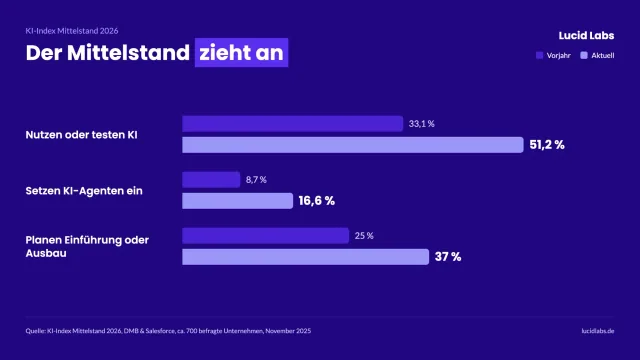
- AI is widespread in companies but rarely scaled: 88% of organizations use AI, but only around a third use it company-wide.
- Managing AI is a job for top management: clear roles, governance in line with the GDPR and the EU AI Act, and consistent KPI tracking decide whether the rollout succeeds.
- Successful projects start with a narrowly defined, measurable use case, not a large-scale program.
- The biggest lever for AI in your company is redesigned processes that were impossible or unprofitable before AI.
Artificial intelligence: where do German companies stand today?
AI has arrived in German companies, but few have embedded it in production. According to the Federal Statistical Office, one in five companies in Germany (20%) used AI technologies in 2024, and the share is rising. Adoption depends heavily on company size: 48% of large companies use AI, compared with 28% of medium-sized companies and 17% of small ones.
The real bottleneck is not using AI but scaling it. In McKinsey’s global survey “The State of AI”, 88% of organizations say they regularly use AI in at least one business function. Only around a third, however, scale AI across the whole company; most remain stuck in pilots and experiments.
This is exactly where companies lose time and competitive advantage. The AI maturity model gives you an honest snapshot: it shows where your company stands today and what the sensible next step is.
The maturity model for AI in companies
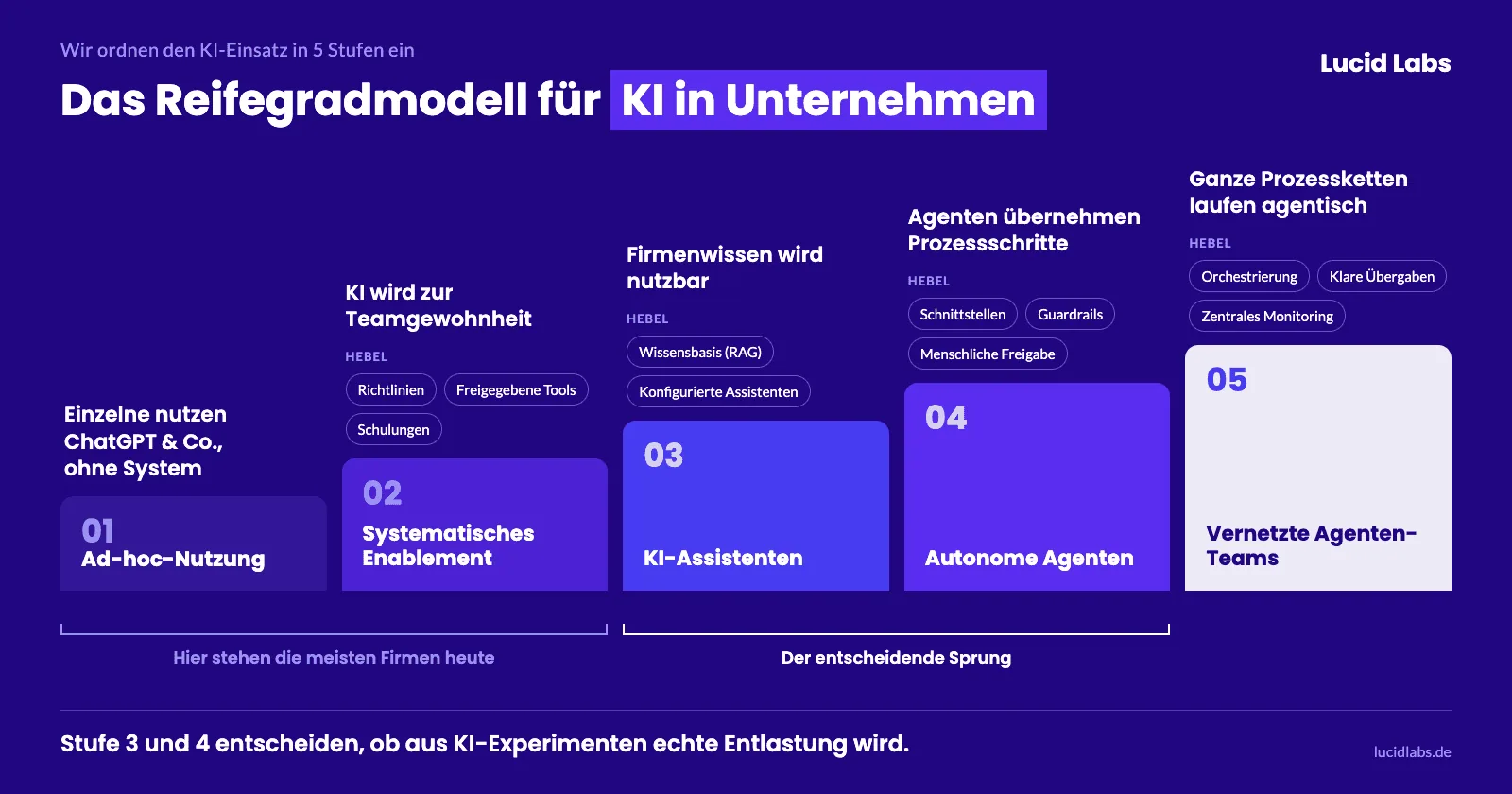
We place AI adoption on five levels:
- Ad hoc use: Individual employees use tools such as ChatGPT or Copilot now and then, with no system behind it.
- Systematic enablement: The team works within clear guardrails, and using AI becomes a daily habit. How do I reach this level? With binding usage guidelines, approved tools, and short training sessions that turn individual experiments into a shared practice.
- AI assistants: Company knowledge is available in a usable form, and recurring tasks run through configured assistants. How do I reach this level? By moving company knowledge into a machine-searchable knowledge base (RAG) and turning recurring tasks into configured assistants.
- Autonomous agents: AI agents handle entire process steps on their own, with approvals at critical points. How do I reach this level? By connecting systems through interfaces, defining guardrails and escalation rules, and raising the level of autonomy step by step with human approval.
- Networked agent teams: Several agents work together as an agent operating system that covers complete process chains. How do I reach this level? By orchestrating several proven single agents, defining clear handoffs between them, and monitoring the whole chain centrally.
Most companies today are at level 1 or 2. That is normal, but at those levels AI does not create measurable value. The step up to levels 3 and 4 decides whether experiments turn into real relief.
Integrating AI in your company: a step-by-step roadmap
Successful AI integration happens step by step, not in one big launch. Each level of the maturity model delivers value on its own and prepares the next. The key is not to skip a level.
Level 1
The first step takes you from ad hoc use to systematic enablement. This is not about impressive demos; it is about your team using AI safely in day-to-day work. Even this step pays off: employees who use generative AI save around 2.2 hours per week on average (St. Louis Fed, 2025).
Level 2
At the next level, you introduce AI assistants. You make company knowledge usable and set up recurring tasks as fixed workflows. Occasional use becomes a reliable process.
Level 3
The biggest lever is the move to autonomous agents. To succeed, you need clean processes, the right context, and clear quality measurement. Raise the level of autonomy deliberately: first drafts, then approval by employees (human in the loop), and later autonomous handling of standard cases.
Important: Too much autonomy too early leads to errors and a loss of trust. Too little autonomy out of caution wastes the potential. You find the right balance by measuring, not by gut feeling.
AI process optimization: finding the right use case
The most common mistake in AI process optimization is starting in the wrong place. Not every process is a good fit, and the most complex one is rarely the right first step. The McKinsey study also shows that deliberately redesigning workflows is one of the strongest drivers of measurable AI value.
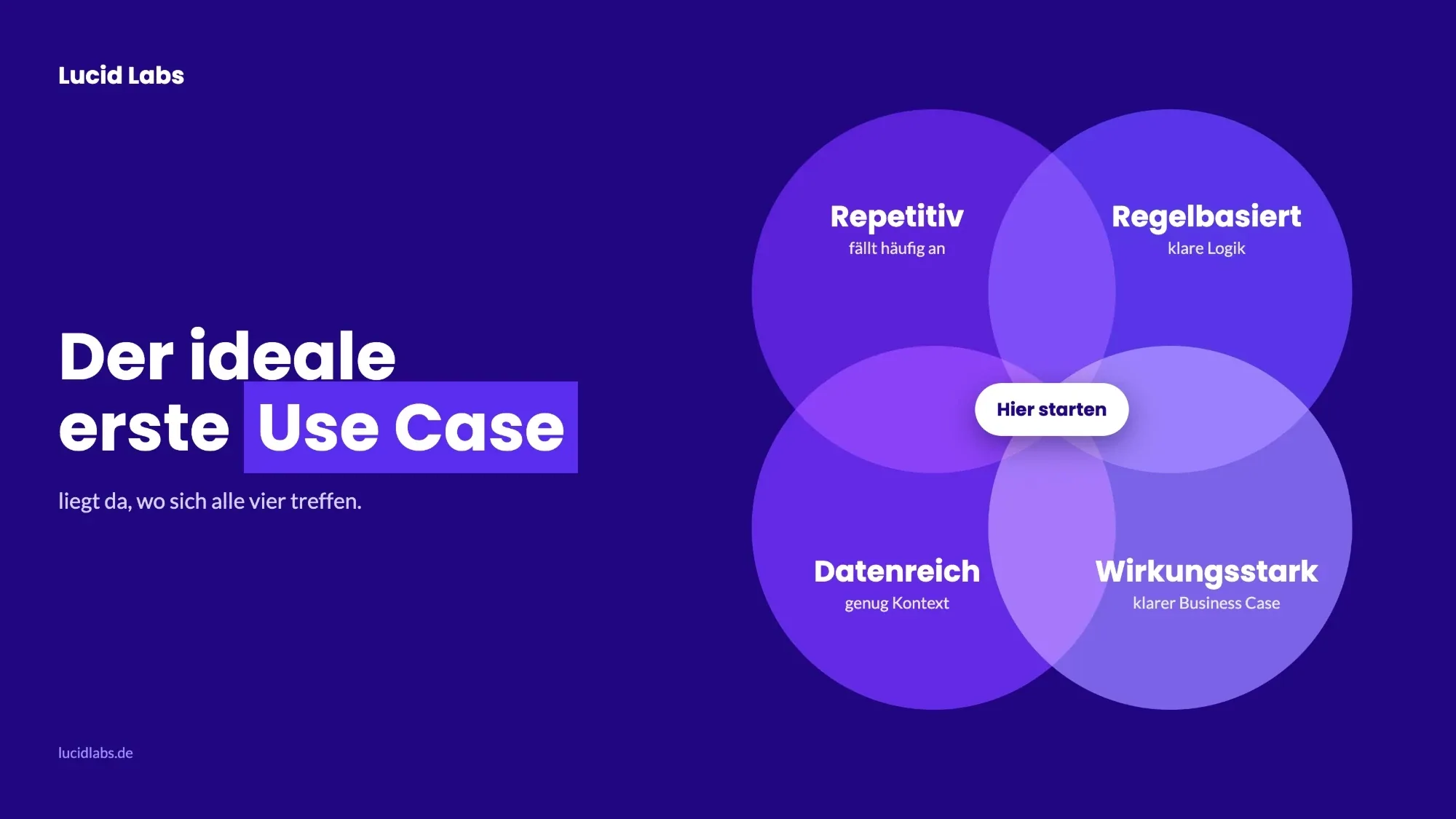
Before you automate, check four criteria. A good first AI use case is:
- Repetitive: The task comes up often, so the potential gain is large.
- Rule-based: It follows a traceable logic rather than being purely creative work.
- Data-rich: There is enough context to feed the AI reliably.
- High-impact: Time saved, frequency, and cost add up to a clear business case.
These criteria give you a simple way to prioritize by effort and impact. Use cases with high value and manageable effort come first. That way, the first project shows results quickly and wins the team over.
The order matters: understand the process first, then automate it. If you put AI on top of an inefficient workflow, you only speed up the wrong thing. In our AI workshop, we break each process down into individual steps with you and decide, step by step, what the AI handles and where a person stays involved.
AI in companies: real-world examples
AI is no longer limited to tech giants. Mid-sized companies in particular see the benefit wherever recurring tasks take up a lot of time. The following Lucid Labs projects deliver measurable results.
| Industry | Task before | Result with AI |
|---|---|---|
| E-commerce | Answering recurring service inquiries manually | 55% of inquiries resolved automatically, response time under 40 seconds |
| Architecture and construction | Tender analysis taking 5 to 7 days per case | Analysis in 1 day, 80% time savings |
| Property management | Reviewing and classifying thousands of tenant emails by hand every day | 81% automation rate, several thousand fewer processing hours per month |
| Cross-industry | Monitoring KPIs manually, reacting late | 90% faster detection of business anomalies |
Many of these solutions combine AI agents with automation platforms such as n8n. Two patterns stand out:
- Successful projects start with a narrowly defined use case, not a large platform.
- They can be measured against specific metrics, from automation rate to response time.
That turns an example into a solid business case instead of yet another pilot without impact.
How do I measure the quality and success of AI in my company?
To assess your AI project reliably, you need a repeatable evaluation of the process. It tells you whether your AI agent is good enough to take on responsibility in your company, and whether it still is after every update. In practice, it covers four elements:
- Test cases (golden set): A fixed collection of real cases with a known correct answer. You use it to check every new version before it goes live.
- Acceptance thresholds: Before go-live, you define the accuracy and escalation rate a use case must reach before it can go into production. The level of autonomy only increases once the threshold is met.
- Human sampling: Your experts continuously review a share of the results. This catches errors that no automated test would find and lets you recalibrate the evaluation.
- Automated evaluation: Once the first critical test phase under human oversight is complete, you can have a second AI model score the answers against clearly defined criteria (LLM-as-a-judge). This scales the review to thousands of cases.
What matters is that measurement runs continuously, not just at the start, because models get updated and your data or requirements change. Running a regression test against the golden set whenever the model changes ensures that a supposed improvement does not quietly lower quality.
How do I manage AI in my company?
Managing AI is a job for top management, not purely an IT project. The most progress happens when leadership sets priorities, approves budget, and uses AI itself. If AI is delegated to IT, you get technology; if leadership drives it, you get transformation.
For this to work, you need clear roles. A designated owner or an external partner identifies use cases, builds solutions, and measures their quality. Managers create room for the work and actively bring their teams along.
Governance includes traceable logs, clear permissions, and human approval at sensitive points. For legally compliant operation, the GDPR and the EU AI Act are decisive: the EU AI Act classifies AI applications by risk and requires transparency and documentation, while the GDPR governs how personal data is handled.
Bringing AI into production in your company with Lucid Labs
As an AI agency, Lucid Labs is a development partner for mid-sized companies. We do more than advise: we build and run the solutions ourselves. We never start with the technology, but with real business cases from your current processes.
Instead of lengthy strategy papers, we deliver production-ready AI agents that hold up in your day-to-day business. You keep full visibility throughout: traceable results, monitoring in live operation, and a clear focus on measurable ROI. When needed, this grows into a complete agent operating system that covers entire process chains.
Get in touch today, free and with no commitment, and let’s explore the potential of AI in your company together in our Executive AI Workshop.
FAQ
How can AI be used in a company?
AI works best when you apply it to specific processes rather than for its own sake. Typical starting points are handling recurring inquiries, document processing, customer service, and reporting. The biggest lever, however, is introducing entirely redesigned processes that were considered unworkable or unprofitable before AI.
Why do so many AI projects get stuck in the pilot stage?
The most common reason is not the technology you use but a lack of focus. Too broad a scope, no clear owner, the wrong business case, or missing quality measurement usually cause projects to fail. Underestimating the integration with existing systems and not understanding the process also slow things down. If you start with a narrowly defined, measurable use case, evaluate it properly, and only then scale it, you will reliably get past the pilot stage.
What are some examples of AI in companies?
Examples range from automated tenant service and multilingual service chatbots to tender analysis and KPI monitoring. In practice, solutions like these can cut your processing times by up to 80%. You can find more examples in our case studies.
What does it cost to introduce AI in a company?
The cost depends on scope and complexity. A narrowly defined first use case costs considerably less than a broad platform rollout. What matters is not the lowest price but the ratio of effort to measurable benefit. Open-source components and operation without vendor lock-in keep running costs predictable.