AI in the energy industry: 5 use cases with ROI for renewable project developers and operations managers
The energy transition is in full swing, and your portfolio often grows faster than you can hire. Every new plant brings more permitting deadlines, SCADA data streams, revenue settlements, investor reports, and contractual obligations. As the plants scale, the office work behind them scales too, but in today’s tight market for skilled workers, you cannot staff it at the same pace.
This is exactly where AI comes in for the energy industry: it automates recurring document and data work and decouples growth from headcount. Whether automation succeeds depends less on the tool than on the processes behind it, meaning clearly defined AI use cases with real data and measurable KPIs.
In this guide, we walk you through 5 specific use cases along the project lifecycle and show what the EU AI Act and the GDPR require of you in practice.
AI in the energy industry: key takeaways
- AI reduces routine daily work along the entire project lifecycle in the energy industry.
- The biggest levers for your renewables portfolio are 24/7 anomaly detection when monitoring 100+ plants and around 80% less effort in revenue settlement per plant per month.
- Investor reporting shrinks from an all-nighter of a quarterly reporting week to half a working day per fund.
- EU hosting and custom workflows (e.g., n8n, Claude Agents) make it possible to comply with the EU AI Act and the GDPR. Tools such as standard ChatGPT are quickly ruled out for SCADA and contract data.
Where AI makes a real difference in the energy sector
As a project developer or operations manager in renewable energy, you lose the most time wherever recurring documents and data pile up: in permitting, in monitoring your plant portfolio, in revenue settlement, in investor reporting, and in contract management. These are exactly the manual processes that AI can automate.
The following overview maps 5 AI use cases to the phases of the project lifecycle and shows where AI realistically pays off.
| Use case | Effort today | AI lever |
|---|---|---|
| Permit documentation tracker | 60–120 hrs per project for tracking and follow-up requests | around 50% less effort |
| Plant monitoring and anomaly detection | impossible to manage manually with 100+ plants | 24/7 detection instead of a daily review |
| Revenue settlement and invoicing | 1–3 hrs per plant per month | around 80% less effort |
| Investor reporting | 2–5 days per quarter per fund | reporting in a few hours instead of days |
| Contract and deadline management | 5–20 hrs/month | around 70% less routine work |
These figures are typical industry values based on experience and serve as a sample calculation. How much you actually save depends on your portfolio size, your plant types, your data, and the templates you already have.
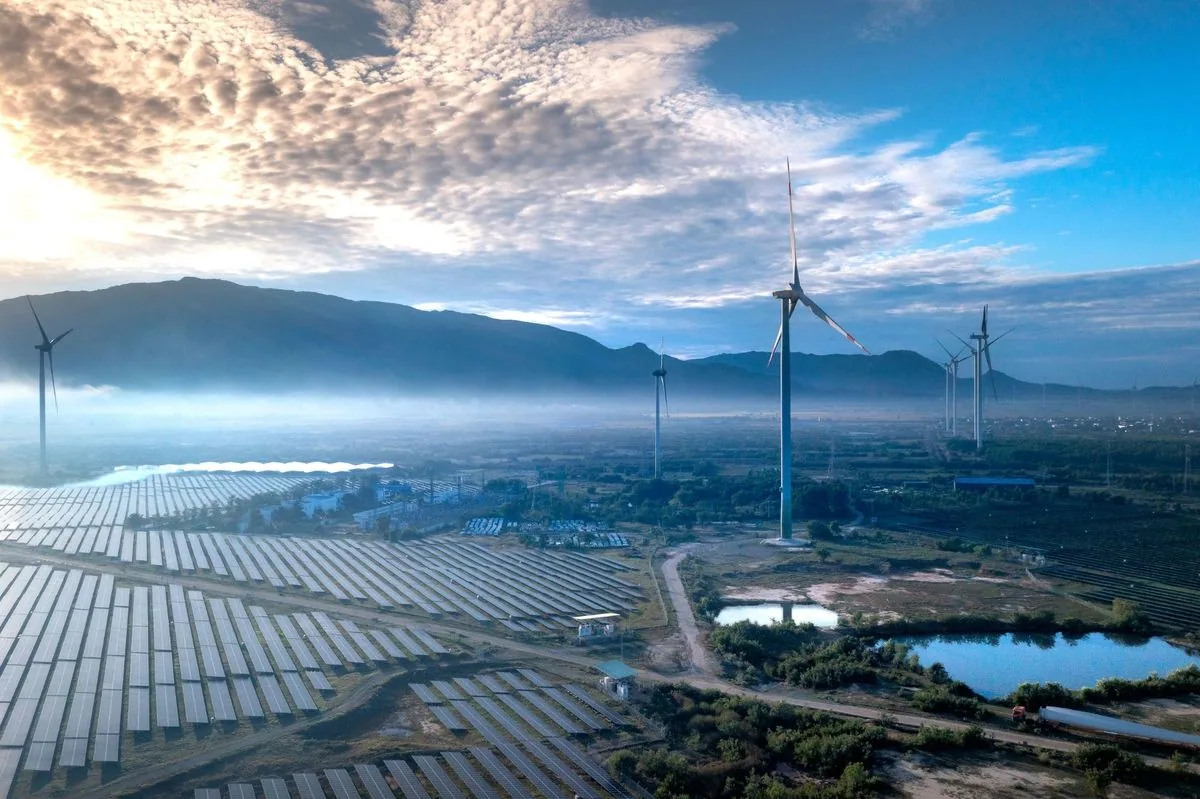
5 AI use cases for renewable energy projects
1. Permit documentation tracker (permitting)
Permitting for wind and solar projects often drags on for 12 to 36 months. You move back and forth between the BImSchG application under Germany’s Federal Immission Control Act, building law, the nature conservation procedure, and municipal participation. Throughout, you have to keep expert reports, plans, forms, and statements from several disciplines up to date.
An AI agent creates a dynamic document checklist for each project and automatically scans incoming correspondence for follow-up requests and conditions. It then assigns each item to the right discipline, reminds the responsible experts, maintains an escalation path for approaching deadlines, and summarizes the open items for your next response to the authority.
Today, tracking and preparing follow-up requests from the authorities takes 60–120 hrs per project. With the right AI templates and automatic evaluation of official correspondence, that effort is cut in half. Following the human-in-the-loop principle, your project managers and lawyers remain responsible for the technical assessment of objections and for direct contact with the authorities.
2. Plant monitoring and anomaly detection (technical operations management)
In technical operations management for wind and solar parks, data flows in around the clock from SCADA, inverter, weather, and grid sensors. Most operators with a portfolio of more than 100 plants have long had a monitoring system in place for this, but it mostly works with fixed thresholds: it raises an alarm when a limit is breached but neither identifies the cause nor sets priorities. The result is a large number of generic alerts that your team has to review and assess one by one. Gradual underperformance below the thresholds, on the other hand, often only shows up in the month-end yield reconciliation, by which time it has already cost yield.
This is where an AI agent comes in. It analyzes the SCADA data streams in real time and compares each plant’s yield and availability with the weather forecast, the planned value, historical performance, and comparable plants in the portfolio.
Instead of a blanket threshold alarm, it delivers an initial diagnosis with the likely cause (e.g., a faulty string inverter, a pitch adjustment issue, module soiling, or a transformer anomaly) and prioritizes maintenance dispatch by yield lost per hour. This also reveals underperformance that stays below conventional alarm limits. The industry association takes the same view: BDEW, the German Association of Energy and Water Industries, sees predictive maintenance as a key lever because wear patterns are detected early, before damage occurs.
Operations management thus shifts from a reactive daily review to continuous monitoring. Anomaly detection runs in the background, while people decide on escalation and maintenance work. Responsibility for the technical plant stays firmly in your hands.
Sample calculation: For an asset manager with 120 PV and wind plants, the main benefit here is avoided yield loss. If gradual underperformance is detected 2 weeks earlier on average, this quickly adds up to a five- to six-figure sum per year for a portfolio of 120 plants. Recovering even 1% of annual yield earlier usually far exceeds the cost of the agent.
3. Revenue settlement and invoicing (commercial operations management)
Every month, commercial operations management faces the same task: the feed-in data from the plant portfolio has to be calculated against whichever remuneration applies. That ranges from EEG subsidies (under Germany’s Renewable Energy Sources Act) with a market premium and PPA tranches with individual price formulas to direct marketing with hourly prices and self-supply shares for own consumption. Each of these contracts generates invoices to grid operators or offtakers, as well as follow-up postings for lease, maintenance, insurance, and direct marketing fees.
An AI agent consolidates the metering data relevant for billing: meter readings that comply with calibration law, MSCONS data from the metering point operator, and the direct marketer’s billing data. It reconciles this data with the remuneration scheme stored for each contract and, from the result, generates ready-to-use draft invoices with references to plant, period, contract, and tax. It matches incoming payments automatically, and open items go into a prioritized dunning pipeline.
Your lever: Revenue settlement currently takes 1–3 hrs per plant per month, which for a portfolio in the hundreds adds up to a substantial block of commercial staff time. With AI templates, the effort drops to around 20% of today’s processing time. Accounting still handles the commercial plausibility checks and final approval: what speeds up is data preparation, not responsibility.
4. Investor reporting (commercial operations management)
Investors and fund companies expect clear quarterly reports per asset or fund: availability, yield, actual vs. plan, cash flow, lease and O&M costs, and any special situations. Today, each report takes several days to prepare. The data from SCADA, accounting, contract management, and the market database is pulled together by hand, and the variances are then commented on manually.
An AI agent pulls the technical and commercial data from these systems in parallel and writes a first draft of the standard sections: the KPI overview, the performance commentary, the status of measures, and a data-driven variance analysis against the budget. It names which KPIs deviate and quantifies by how much. The asset manager remains responsible for the strategic interpretation of why, and for communicating with investors.
Sample calculation: An asset manager with 4 funds currently spends 3 days per fund per quarter on investor reporting, i.e., 48 person-days a year. With an AI report generator, it takes 0.5 days per fund, or 8 person-days a year. That frees up around 40 working days a year for investor meetings and portfolio strategy.
5. Contract and deadline management (compliance)
In a portfolio of more than 100 plants, the compliance burden lies in hundreds of contracts: lease agreements with indexation, maintenance contracts with service levels, and direct marketing and PPA contracts with adjustment clauses, plus permit conditions with annual verification requirements and certificates such as the feed-in certificate under VDE-AR-N 4110. Missed deadlines quickly become expensive, because contractual penalties, remuneration risks, official requirements with short-notice proof, and insurance gaps add up fast.
An AI agent indexes your contract and permit documents and extracts deadlines and conditions automatically. For each one, it assigns an owner, a reminder path, an escalation level, and a set of templates for the required evidence. When contracts change, it updates the inventory, and when a deadline approaches, it generates a checklist of all the supporting documents needed.
Sample calculation: An asset manager with 120 plants and around 600 active contract and permit-condition deadlines currently spends 12 hrs/month on tracking deadlines and contracts alone, or about 145 hrs/year. With an AI agent, it is around 4 hrs/month, or about 50 hrs/year. On top of that, every deadline breach avoided in permitting or PPAs saves four- to five-figure follow-up costs.
AI Act and data protection for renewable energy project developers and operations managers
Since February 2025, Article 4 of the EU AI Act has required every company that uses AI to train its employees in AI literacy. Renewable energy project developers and asset managers are explicitly not exempt.
Then there is the GDPR: SCADA data, permit documents, PPAs and lease agreements, and investor reports have no place in consumer tools such as standard ChatGPT.
A more practical route is AI solutions that are hosted in the EU or run on-premise, with clear roles and clean logging. Energy plants above certain size thresholds also fall under the BSI-KritisV, Germany’s ordinance on critical infrastructure. This brings additional IT security and verification obligations that you should factor in from the start when selecting tools.
AI in the energy industry with Lucid Labs
Lucid Labs is the AI partner for renewable energy project developers and asset managers who want measurable results in weeks rather than months. We always start with the Executive AI Workshop, where we work with your leadership team to collect all relevant use cases across your project and operations phases and assess them by effort and benefit.
The result is a prioritized action plan with the most promising AI use cases for your company, the direct precursor to your AI roadmap. It shows you where the first agent goes live and in what order the next ones follow.
We then build your new agents. Integration with your existing SCADA and ERP landscape and EU hosting are standard, and we also handle the employee training that the EU AI Act requires.
FAQ
Which AI is right for renewable energy project development and operations management?
That depends heavily on the use case. For permit tracking, revenue settlement, investor reporting, contract management, and plant monitoring, we build custom workflows, for example based on n8n or Claude Agents, that work directly with your own templates and systems.
This lets you connect SCADA data, contract documents, accounting interfaces, and investor platforms cleanly, without tying yourself to a vertical software vendor. Generic consumer tools such as standard ChatGPT are usually too unspecific for these applications and not suitable under the GDPR.
What does introducing AI realistically cost a project developer or asset manager?
That depends on the size of your portfolio and your ambitions. The starting point is always our AI workshop, including a preliminary analysis, joint use case development, a cost-benefit assessment, and a prioritized action plan, at a fixed price starting at €7,000. Based on the prioritized use cases, we then provide a transparent cost estimate for implementing the first agents.
What does the EU AI Act training requirement mean for the energy industry?
Since February 2025, every company that uses AI has had to train its employees in AI literacy, regardless of size or industry. If you use AI in production for plant monitoring, revenue settlement, investor reporting, or contract management, you need documented basic training on how AI works, its risks, the obligations involved, and how to use AI safely.