AI for mid-sized companies: how to get from AI experiments to a productive organization
Enthusiasm for AI has reached mid-sized companies, but measurable business results often have not. Tools are in place and individual teams are experimenting, yet little changes across the company as a whole. This guide explains why, and how mid-sized companies move AI from experiments to measurable results in production.
AI for mid-sized companies: key takeaways
- Around half of Germany’s mid-sized companies already use or test AI, but only a few see measurable business results from it.
- The most common mistake is to change the tool and leave the operating model as it is.
- The real impact comes when AI automates processes, or when companies redesign those processes from scratch.
- The best way to start with AI is step by step: pick one time-consuming process, build an agent, measure the impact, and then scale.
Where does the German Mittelstand stand on AI?
The “KI-Index Mittelstand 2026”, published by the Deutscher Mittelstands-Bund (DMB), a German association of mid-sized businesses, together with Salesforce, tracks how mid-sized companies are adopting AI. For the latest edition, around 700 mid-sized companies were surveyed in November 2025:
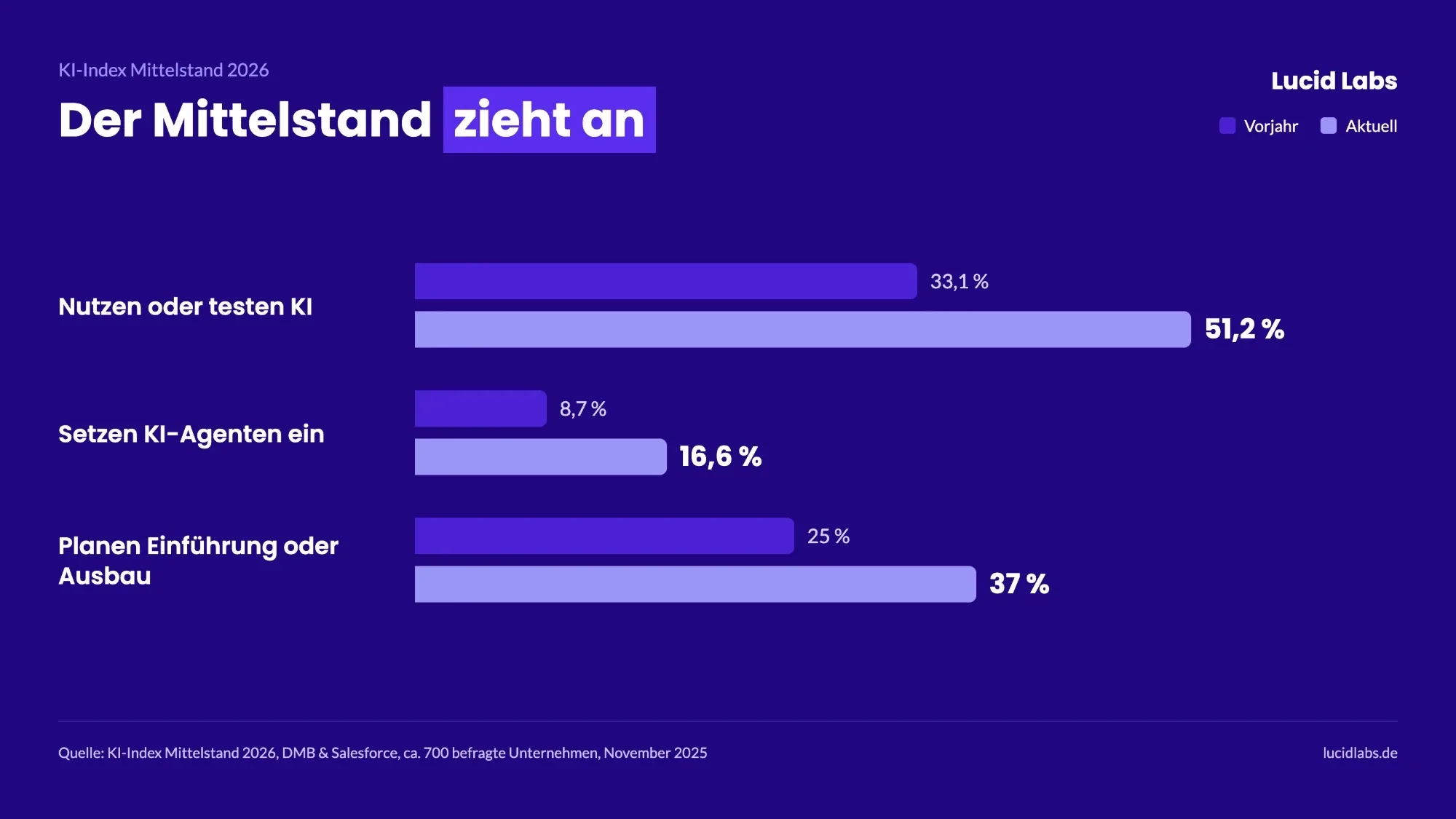
- 51.2% of mid-sized companies used or tested AI in 2025, about half as many again as the year before (2024: 33.1%).
- 16.6% already use AI agents that take on tasks independently and orchestrate processes, almost twice as many as in 2024 (8.7%).
- 37% plan to introduce AI in 2026 or expand existing applications (previous year: 25%), while the share with no specific AI plans has fallen from over 40% to 31%.
- The main drivers are more efficient internal processes (54.4%), productivity (44%), cost savings (41.1%), and better data analysis (35.2%).
So the trend is pointing the right way. What many companies still lack is less the technology than a sense of direction:
- 39.9% want more knowledge about specific areas of application,
- 32% want better protection of data and trade secrets,
- 26.6% want more legal clarity,
- 23.7% want better data quality.
These are the points that decide whether enthusiasm turns into measurable results.
Why does AI often not (yet) deliver measurable results for mid-sized companies?
Many companies change their tools but leave their operating model untouched. They hand out licenses, individual employees use ChatGPT or Copilot, and the processes behind the work stay the same. At best, the result is a few isolated wins with no effect on the company as a whole. According to McKinsey, more than 80% of companies see no noticeable effect of generative AI on their EBIT at the enterprise level.
Background: why is introducing a tool not enough on its own? To illustrate the point, we like to look back at industrial history. Around 1900, factories replaced their central steam engine with electric motors but left the layout of their halls unchanged, and the hoped-for leap in productivity never came. The breakthrough only arrived once they reorganized their factories around the new technology, with a separate drive at each machine and redesigned material flows. → What made the difference was not the tool alone, but the operating model.
AI projects at mid-sized companies often fail at these 3 levels
- Tool first instead of process first: The first question is usually “Which tool?” rather than “Which process offers the biggest lever?” Yet redesigning workflows is what has the greatest effect on the value AI delivers.
- The use case is too broad: “We are automating our entire customer service” sounds ambitious, but it is hard to measure and rarely succeeds. The broader your use case, the blurrier the data, the quality criteria, and the business case become. AI only becomes reliable on a narrowly defined process with real data, where a specific KPI shows whether it works. From there, you can scale.
- AI without clear ownership: Many pilots work in testing and then fizzle out because no one has defined who runs the agent, who checks the results, and how outliers are handled. Without documented process knowledge, clear approvals (human in the loop), and ownership in the business unit, even a good agent remains an experiment.
→ All 3 patterns share the same root cause: AI is treated as one more tool, not as a new part of the operating model. Companies that avoid these mistakes are already ahead of most. Only when processes are redesigned around AI and firmly embedded in the organization can enthusiasm turn into measurable impact.
What potential does AI offer mid-sized companies in particular?
For a mid-sized company, the biggest lever lies where recurring, knowledge-intensive tasks take up a lot of time and skilled staff are scarce. AI agents and assistants take over routine work and free up capacity for work that creates value. This lets you grow without increasing personnel costs at the same rate.
For SMEs, AI pays off on 4 levels in particular
- 1. Time: Routine tasks such as document checks, data entry, or standard inquiries run automatically instead of by hand.
- 2. Costs: Less rework and shorter turnaround times reduce operating costs measurably.
- 3. Quality: Standardized processing reduces transcription errors and keeps documentation complete.
- 4. Scalability: A successful use case becomes a pattern you can apply to other processes.
Applications range from knowledge management and customer communication to reporting and back-office work.
What is changing right now: from assistant to AI agent
Until recently, “AI in the company” mostly meant assistance: an employee asks a question, the model returns a draft, and the person does the rest. That can be useful, but it depends on the individual and has no effect on your organization as a whole.
The shift now underway is away from the AI assistant that answers questions and toward the AI agent that takes on tasks and carries out entire process steps on its own. The KI-Index Mittelstand already shows that the share of companies using AI agents in production has nearly doubled within a year.
Our view:
Over the next few years, this is where the gap between followers and leaders will be decided. Not because the models are getting better (they will anyway), but because the real value lies in the process and context work around them:
- in the connection to your data and systems,
- in clear rules, and
- in orchestrating several agents into connected workflows.
→ Companies that still run AI as an assistant alongside their old processes will be overtaken by those that reorganize their workflows around agents and capture the efficiency gains that come with it.
AI at mid-sized companies: real-world examples
The following 2 Lucid Labs projects show how a clearly defined process leads to a measurable reduction in workload.
Controlling agent for variance analysis
Before: Ahead of every month-end close, the business partners and the financial accounting team at a mid-sized group of companies checked thousands of individual postings by hand for plausibility, spending several hours per company.
After: An AI agent now runs this analysis automatically. It spots missing recurring postings, validates cost centers against historical patterns, and flags unusual amounts before the close.
Measurable result: Review time drops from several hours to a few minutes per company, and the finance team focuses on the few outliers that matter instead of thousands of unremarkable postings.
Tenant service agent in property management
Before: A mid-sized property management company handles several thousand emails and calls from tenants and owners every day. Reviewing, classifying, and processing them by hand took a lot of time and was almost impossible to scale.
After: Today, an AI agent analyzes incoming emails, including PDF, DOCX, and image attachments, identifies the request, prioritizes it, and creates structured tickets in the property management system. When one email contains several requests, the agent handles each of them separately.
Measurable result: The agent reaches an automation rate of 81% in production and cuts manual processing by several thousand hours per month.
Both examples follow the same pattern: a narrowly defined process with real data, measured against specific KPIs. You will find more ways to use AI at mid-sized companies in our list “13 AI use cases for mid-sized companies” and in our client projects.
What mid-sized companies need to consider when using AI
For AI to work reliably at a mid-sized company, the tool matters less than the foundations behind it. Pay particular attention to these 4 points.
- Data and process knowledge: AI applications need accessible data and documented process knowledge. Where information is scattered or unstructured, there is no basis for reliable results. That is why the first step is often to capture knowledge and prepare data.
- Know-how and acceptance in the team: The biggest hurdle is rarely the technology; it is a lack of know-how and the reservations people have. AI should not be imposed from the top down but developed together with the employees who work with the processes every day. Involving and training them early builds trust.
- Data protection and regulation: Sensitive company and personal data need clear rules. The GDPR governs how personal data is handled, while the EU AI Act classifies AI applications by risk level and, depending on that level, requires transparency and traceability. Planning for this early avoids costly rework.
- Control and secure operation: EU hosting, role-based access, logging, and approvals at critical points (human in the loop) keep AI traceable and auditable. Solutions without vendor lock-in also keep your dependence on individual providers low.
With these foundations in place, a pilot becomes a robust operation. That leaves the practical question of how to get started.
Checklist: how to get started with AI-driven processes
Mid-sized companies do not get started with AI through one large project, but step by step, one process at a time. This checklist runs in chronological order from the first assessment to a growing agent system.
Weeks 1–2:
- ☐ Assess your processes: Identify recurring, time-consuming processes and prioritize them by effort and impact. Guiding question: which recurring task currently costs your team the most time?
- ☐ Lay the foundations: Document the process knowledge you need, define rules, and make the relevant data accessible.
- ☐ Set quality criteria: Before you start, define what a good result looks like and which KPIs you will use to measure it.
Weeks 3–6:
- ☐ Build and test the first agent: Implement one narrowly defined use case, initially with approvals by employees (human in the loop).
- ☐ Measure the impact: Compare before and after against the KPIs you defined and validate the business case.
From week 6:
- ☐ Roll out and tackle the next lever: Apply the successful use case more widely and move on to the next process.
From month 3:
- ☐ Expand into an agent system: Connect several agents into workflows that cover entire process chains.
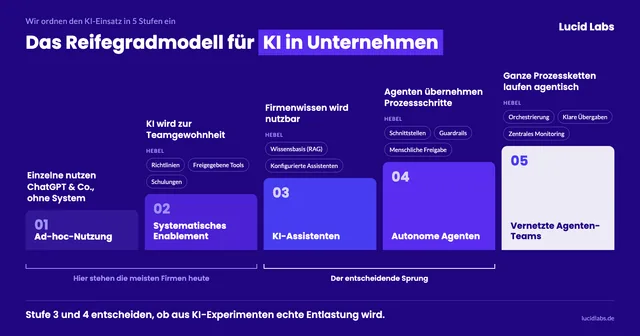
The key is to start early. Every week an automatable process still runs manually, it ties up valuable capacity that you need elsewhere. Our guide to AI in companies shows the stages from ad hoc use to connected agent teams.
Lucid Labs brings AI to mid-sized companies
If you want AI to be truly productive at a mid-sized company, you do not need another tool vendor. You need a partner who understands processes and builds the solutions itself. That is where we at Lucid Labs come in: our AI consulting for mid-sized companies is always tailored to your situation rather than forcing a one-size-fits-all template on you.
Our AI workshop never starts with the technology. It starts with your processes and the business cases that follow clearly from them. In the workshop, we identify those business cases and develop a practical AI strategy for you that goes straight into production-ready AI pilots, instead of burying you in dozens of pages of white paper.
If the pilots succeed, they grow into a complete agent operating system that can cover entire process chains.
Enthusiastic, but never reckless. We develop the solution with your employees, measure success against clear KPIs, and run the agents responsibly in line with the GDPR, with EU hosting.
FAQ
What does AI actually deliver for mid-sized companies?
AI handles recurring, time-consuming tasks and frees up capacity despite the shortage of skilled workers. In practice, solutions reach automation rates of over 80% or cut processing times from several hours to a few minutes. What matters is a clearly defined process with measurable KPIs.
What is an AI agent, and why isn’t ChatGPT enough?
An AI agent in production is a tested workflow built into your process, with access to your data and your SOPs, that reliably achieves 90–95% and documents the result. With a standalone LLM such as ChatGPT, you get a good first result, but nothing more. The difference is not the model behind it but the process and context work around it.
Will AI replace our employees?
As a rule, no, because growing mid-sized organizations already have more work than they can hire people for. What actually happens is that repetitive tasks are delegated to AI, and people can focus on higher-value work. At one of our clients, for example, 5 full-time positions were reassigned and not a single one was cut.
What does a mid-sized company need in place before using AI?
The foundations come before the technology: accessible, clean data, documented process knowledge, employees who are involved, and legally compliant operation under the GDPR and the EU AI Act. If you start small and measure against KPIs, you need neither a large IT department nor a big upfront investment.
Can mid-sized companies use AI in a GDPR-compliant way?
Yes, if operations are set up accordingly. With EU hosting, role-based access, logging, and approvals at critical points, AI can be run in a traceable, privacy-compliant way. The EU AI Act adds risk-based transparency obligations to the GDPR.