ChatGPT in business: what it can do, where its limits are, and who it’s worth it for
The AI assistant for everything. That sums up ChatGPT’s claim. Write copy, analyze data, generate images, debug code, research the web: all in one chat window that most of your employees already know from personal use.
ChatGPT – As of February 2026
- GPT-5.2 has been the flagship model since December 2025, available in three variants: Instant (fast), Thinking (structured), and Pro (precise). Knowledge cutoff for all variants: August 2025.
- Older models such as GPT-4o and o4-mini will be removed from ChatGPT on February 13, 2026.
- Company Knowledge connects internal systems such as Slack, SharePoint, and Google Drive directly to ChatGPT (Business and Enterprise plans only).
- According to OpenAI, hallucinations have been reduced but not solved. An independent study found nearly 20% entirely fabricated citations in academic contexts.
- The free version still uses inputs for model training. Only the Business and Enterprise plans guarantee that business data is not used for training.
- Agent Mode is currently not available under EU regulation.
What is ChatGPT?
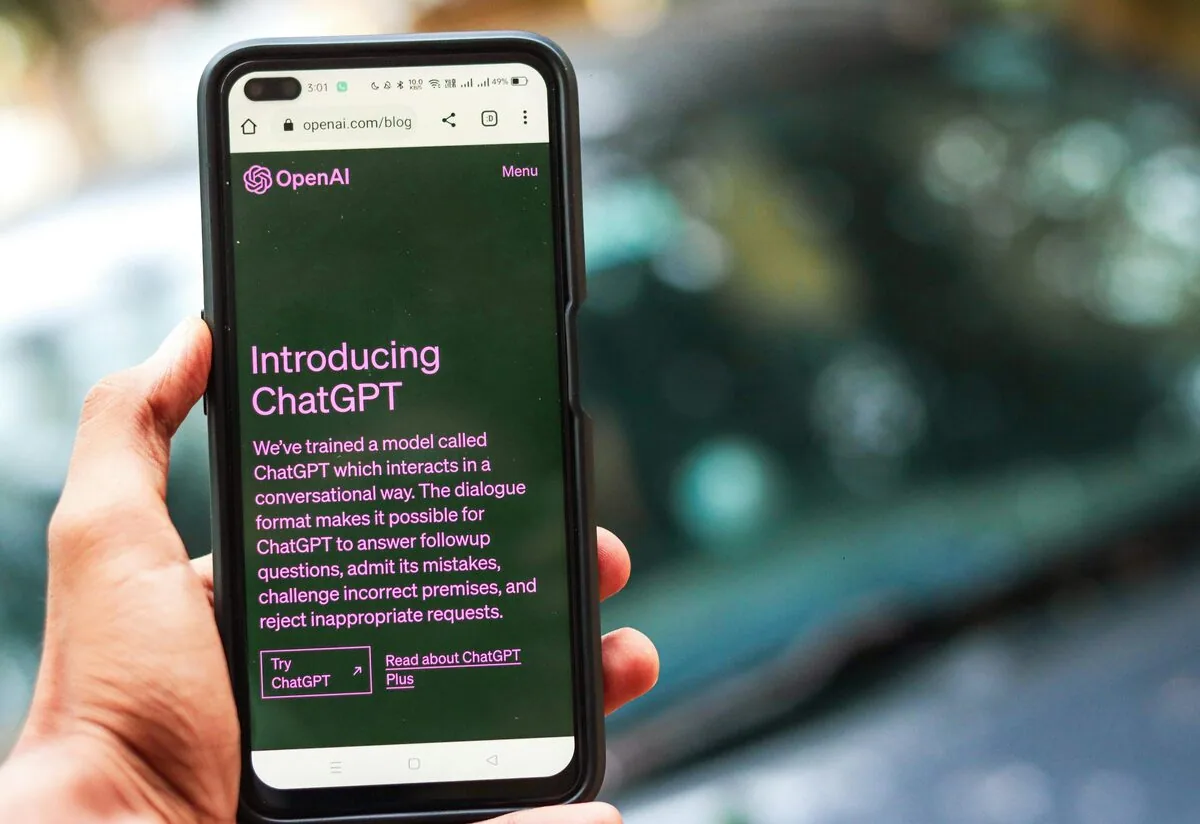
ChatGPT is a general-purpose AI assistant from OpenAI that understands and generates natural language. It is built on large language models that, at their core, predict which word should come next, at a level that makes complex tasks such as summaries, analyses, and code generation possible. GPT-5.2 adds agentic tool calling: the model decides on its own whether to run a web search, execute Python code, or analyze a file, and combines these tools in a single step.
Unlike Microsoft Copilot or Google Gemini, ChatGPT is not tied to a particular ecosystem. Instead, it offers its own connectors to common business tools through “Company Knowledge.” The strategic advantage is breadth over depth: “good enough” for most tasks, all in a single interface.
What is ChatGPT suited for?
1. Writing internal reports and meeting summaries
Documentation eats up time. Turning meeting notes into structured reports with key points, action items, and decisions is a task that, in many companies, ends up resting on a few individuals. ChatGPT handles exactly that: you paste in pre-structured notes and get a consistent summary back.
The same works for sales reports, project status reports, and market analyses. OpenAI states that Enterprise users save an average of 40 to 60 minutes a day (vendor figure, not independently verified). It works best with pre-structured notes, not raw transcripts.
2. Analyzing and visualizing data without specialist skills
For companies without a dedicated data analytics team, this is one of the strongest levers. You upload an Excel or CSV file and ask questions in plain language, for example: “Show me revenue development by region compared with the previous year.”
ChatGPT spots trends, creates visualizations, and can turn unstructured data such as customer feedback into tables with categories, sentiment, and priority. No Python or SQL required. This democratizes data analysis: teams can run analyses on their own that used to depend on IT or external service providers.
3. Content creation for marketing and communications
ChatGPT works well as a drafting assistant for emails, social media posts, newsletters, blog drafts, and job ads. It helps with brainstorming, produces first drafts, and checks tone and structure for consistency. One expectation to set early: AI-generated content needs significant human editing to match your brand voice. Plan to spend 30% to 50% of the time on editing.
ChatGPT produces drafts, not publication-ready copy. It becomes especially effective with Custom GPTs trained on your brand guidelines, which also shortens onboarding for new team members.
4. Company-wide knowledge search with “Company Knowledge”
This feature is especially relevant for companies whose information is spread across many systems. Company Knowledge connects Slack, SharePoint, Google Drive, GitHub, Asana, and other tools, and delivers company-specific answers with clear source references.
An example: before a client meeting, ChatGPT compiles a briefing from recent Slack messages, call notes, and open support tickets. For mid-sized companies that work across many separate systems, this breaks down information silos. Company Knowledge respects existing permissions: ChatGPT only sees what the user is already allowed to see. It requires the Business or Enterprise plan. A pilot with one team can be up and running within a few days.
Our assessment
Where it pays off
ChatGPT is the broadest AI tool on the market. It is good enough for most tasks, and thanks to its massive consumer adoption, it has the lowest barrier to entry of any enterprise AI tool. If your employees already use ChatGPT privately, rollout moves much faster. Pilot projects are shorter, and adoption is higher than with unfamiliar tools.
Specifically, ChatGPT pays off for companies with 20 to 200 employees who handle recurring writing work every day: reports, emails, documentation. No setup is required, and the ROI shows up fastest. It also suits teams without a dedicated data analytics function that still need to analyze data regularly, and companies with scattered information systems that want to break down knowledge silos with Company Knowledge.
Where it is the wrong choice
-
Not for business-critical fact work without human verification. One Reddit user puts it plainly: “I have to double-check everything it says.” An independent study also found nearly 20% entirely fabricated citations in academic contexts (source: JMIR Ment Health 2025). Error rates rise significantly on niche topics.
-
Not for companies that need GDPR compliance but only want to use the free version. Free and Plus are effectively unsuitable for processing personal data in compliance with GDPR. The minimum is the Business plan with a Data Processing Addendum.
-
Not for teams that rely on long, continuous conversations. Power users in the OpenAI Community Forum consistently report: “The model often repeats previous answers verbatim, even when asked different questions… making it feel as if the model is stuck.” Response quality drops noticeably after 10 to 20 exchanges. The workaround: short sessions and managing context manually.
-
And not without an internal AI policy. According to current research, around one third of employees access ChatGPT through personal accounts and often enter sensitive data in the process (source: Cyberhaven). Shadow AI is a real risk. That is why, since February 2025, the EU AI Act has required AI literacy training for all employees who use AI tools.
Lucid Labs recommendation
We recommend ChatGPT as an entry-level tool for mid-sized companies if these three conditions are met:
-
At least the Business plan for company data. Free and Plus are not sufficient for business use involving personal data.
-
An internal AI policy. This is not optional. Your employees are already using ChatGPT; the only question is whether they do so with rules or without them.
-
Realistic expectations. ChatGPT is a drafting assistant, not a finished product. The ROI comes when you let ChatGPT cover 80% of the way and do the last 20% yourself.
Companies that work exclusively in the Microsoft 365 ecosystem should evaluate Copilot. Teams that mainly use Google Workspace may be more efficient with Gemini. For highly sensitive data with zero tolerance for cloud processing in the US, ChatGPT is not the first choice, even on the Enterprise plan.
Outlook: Agent Mode, in which ChatGPT carries out multi-step tasks on its own, is promising but currently not available under EU regulation. For mid-sized companies in Germany, it remains a prospect for the future.
Next step
Wondering which AI tool fits your processes? In our AI Springboard, we assess this together and give you a personalized recommendation.
FAQ
Can we use ChatGPT in our company in compliance with GDPR?
Not with the free version, which uses inputs for model training by default. For use that is as GDPR-compliant as possible, you need at least a Business or Enterprise plan with a signed Data Processing Addendum. In these plans, training on business data is disabled by default. A residual risk remains because data is processed on US servers. Since February 2025, the EU AI Act has required AI literacy training for all employees who use AI tools.
How reliable are ChatGPT’s answers?
Not reliable enough to trust blindly. ChatGPT hallucinates: it occasionally produces plausible-sounding but factually wrong information. An independent study found nearly 20% entirely fabricated citations in academic literature reviews (source: Deakin University, 2025). Error rates are lower for well-researched topics and higher for niche subjects. Rule of thumb: use ChatGPT as a drafting assistant and always have a person verify business-critical facts.
How does ChatGPT Business differ from Plus?
Plus is a single-user subscription with access to advanced models and higher usage limits. Business is designed for teams of two or more users and offers shared workspaces, admin controls, SOC 2 compliance, and a guarantee that business data is not used for model training. For companies that process personal or sensitive data, the Business plan is the minimum. You can find current prices on the official pricing page.
Do we need an internal AI policy when introducing ChatGPT?
Yes, without exception. Studies show that employees are already entering sensitive company data into ChatGPT, often without realizing it. Without clear rules (what may be entered, which plan is used, who reviews the output), shadow AI takes hold: uncontrolled AI use with data protection and quality risks. Since February 2025, the EU AI Act has required demonstrable AI literacy for all employees who use AI tools.