Agentforce: a reality check of Salesforce’s autonomous AI agent platform
Digital labor. With Agentforce, Salesforce promises nothing less than AI agents that do not just answer but decide, plan, and complete entire business processes on their own, from support tickets to lead qualification. That is ambitious, and no other agent platform is integrated as deeply into CRM. We look at what Agentforce really delivers, where its limits and cost traps are, and who should get started with it.
Agentforce – As of July 2026:
- From July 13, 2026, the new conversational Agentforce Builder is mandatory and replaces the old one
- Since May 2025, billing has run mainly on Flex Credits (pay per action): 100,000 credits cost around $500, a standard action around $0.10
- Without Data Cloud (Data 360), Agentforce works only to a limited extent; data quality decides between success and hallucination
- GDPR-compliant via the Hyperforce EU Operating Zone (Frankfurt/Ireland), including the C5 attestation (Germany) and EU Cloud Code of Conduct Level 2
- A Salesforce study found only 58% success on simple tasks, a figure the vendor published itself
- Realistic total cost is 2 to 4 times the Agentforce costs alone, plus an initial partner setup of €50,000 to €150,000
What is Agentforce?
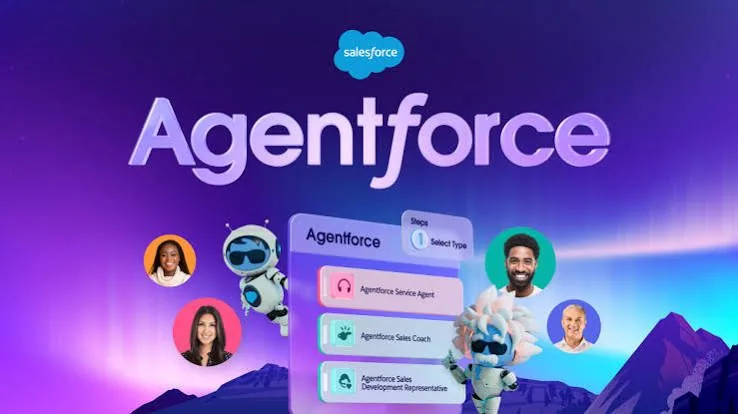
Agentforce is Salesforce’s platform for autonomous AI agents; the vendor calls it “digital labor.” Unlike a chatbot that only generates text, the agents are meant to act on their own: resolve cases, update records, qualify leads, and trigger workflows. Salesforce calls this the “third wave of AI,” a shift from the assisting copilot to the proactive agent that sees tasks through to completion.
The technical core is the Atlas Reasoning Engine, a proprietary planner. Put simply, Atlas breaks a request into steps: recognize the intent, choose the right topic, build a plan, execute it, and check the result. Underneath, interchangeable language models do the work (GPT by default, Claude via Bedrock, Gemini, or a custom model). What matters most is how deeply it is anchored in the Salesforce universe. Agentforce sits as an agentic layer on top of CRM, Data Cloud, Flows, Apex, Slack, and MuleSoft, so it can trigger real actions in existing processes rather than just talk about them.
This depth is what sets it apart from the competition. Compared with Microsoft Copilot Studio: Copilot is strong in the Microsoft 365 and Graph world and is low-code friendly, but it reaches less deeply into CRM actions. Compared with ServiceNow AI Agents: ServiceNow centers on workflows and governance and is strong in IT service management, while Agentforce focuses on Customer 360 and data unification. If you are at home in the Salesforce ecosystem, you get an agent layer here that no competitor offers with this proximity to CRM.
Key features in brief:
- Atlas Reasoning Engine, with a hybrid approach that combines deterministic logic and LLM reasoning.
- Einstein Trust Layer: PII masking, zero-retention agreements with the model providers, protection against toxicity and prompt injection, and an audit log.
- Data Cloud (Data 360) as the data foundation: zero-copy, RAG, vector, and knowledge graph.
- Native integrations via MuleSoft, Slack, Apex/Flow, API, and MCP. Agentforce can be used outside Salesforce, but you only get the full benefit inside the ecosystem.
Agentforce comes from Salesforce itself, the CRM market leader based in San Francisco, led by founder and CEO Marc Benioff. The platform was unveiled at Dreamforce in September 2024 and has shipped at a rapid pace since: version 2.0 in December 2024, 3.0 in June 2025, the unified “Agentic Enterprise” platform Agentforce 360 in October 2025, and, in April 2026, the back-office offshoot Agentforce Operations. The pace is real, and it also means that features and pricing shift quickly.
What is Agentforce suited for?
Customer service deflection for tier-1 tickets
This is the classic and strongest use case. A customer asks a question via chat or WhatsApp; the agent checks Data Cloud, resolves the case, updates the record, and, if needed, escalates to a human with a clean summary. The target group is service teams of 10 to 500 agents in retail, telecommunications, or financial services. The limitation: complex cases that span several systems still end up with people, and without well-designed topics, the hit rate stays low. Real-world figures vary widely. OpenTable reports 70% deflection at first level, AGIBANK 80% call deflection, and Smartsheet raised its rate from 28% to 47% (all according to the vendor). Salesforce says its own help portal resolves 70% of more than four million tickets autonomously.
SDR agent for lead qualification
An inbound lead arrives, and the agent sends personalized emails or text messages, handles nurturing, books meetings, and hands over to sales with a briefing. This suits B2B sales teams with 5 to 50 SDRs. The honest limitation: opt-out compliance and clean lead scoring are mandatory, or you will automate mistakes at scale. Siemens reports a 45% increase in qualification and 1,200 hours saved per agent (according to the vendor, not independently verified).
Field service via voice agent
A technician calls the voice agent, dictates the form, books an appointment, and orders parts. Target group: manufacturing and facility management. This is where a real limit shows. Voice latency and a working ERP integration are prerequisites, and the nuances of German technical jargon are not handled perfectly, despite the 2026 language updates. PepsiCo showed a demo in 2026; Miller Bros Solar and Finnair report shorter handling times.
Internal employee agents for HR and IT
“I’d like to request time off.” The agent checks the policy, creates the request, and updates the system. This only makes sense from around 200 employees and depends heavily on data. Big Brothers Big Sisters reports matches made twice as fast, and Prudential reports hours saved per week.
A word on expectations. You might assume that once it is set up, an Agentforce agent works like an autonomous employee. It does not. Designing topics and actions takes real effort: expect two to four weeks per agent plus ongoing tuning. In our evaluation, this was exactly the underestimated cost. It is not the license that is expensive, but the weeks it takes until an agent reliably does the right thing.
Our assessment
Where Agentforce pays off
- Companies that already use Salesforce as their core CRM and are prepared to invest in Data Cloud. This is where Agentforce’s unmatched depth comes into play.
- Service organizations with high ticket volumes and good data quality. This is where ROI shows up fastest, often within 3 to 6 months according to partner reports.
- Larger mid-sized companies and enterprises with in-house Salesforce developers or a strong implementation partner who can design topics and actions professionally.
Where Agentforce is the wrong choice
- Without a clean Data Cloud, Agentforce is a risk, not a tool. Salesforce itself warns that poor data quality leads to hallucinations, wrong actions, and low deflection. In practice, untuned agents hallucinate in 5% to 15% of cases. A Reddit user on r/salesforce sums it up: “Setup effort high, success 50% depending on data quality.”
- Consumption pricing is hard to predict. Every action is billed via Flex Credits. Without active monitoring in the Digital Wallet, you risk surprise invoices. A realistic example: 1,000 service conversations with three actions each cost around $900 to $1,800 per month, for the actions alone, excluding Data Cloud and licenses.
- Total cost is the real issue. You need at least the Enterprise Plus edition plus Data Cloud. Realistic total cost is 2 to 4 times the Agentforce costs alone. An initial partner setup costs €50,000 to €150,000 and takes 3 to 6 months. A scenario for a mid-sized company with 200 users and 10,000 conversations typically comes to €4,000 to €12,000 per month, including Data Cloud. This is not a tool you introduce on the side.
- Read the success figures with caution. Salesforce’s own study found only 58% success on simple tasks. Internally, there was criticism of LLM reliability: with more than eight instructions, the model reportedly “forgets” some of them. And the much-cited support restructuring, in which Benioff wanted to cut support staff from 9,000 to 5,000, was later partly reversed, with employees redeployed. Frankly, when even the vendor corrects its staffing plans, the “set and forget” narrative deserves some skepticism.
- Without Salesforce at the core, it is simply the wrong platform. With a fragmented data landscape or a multi-stack environment, the effort cannot be justified, because the foundations are missing: unified data, native actions, a CRM base. If Salesforce is only one part of your stack, you are better off with Microsoft Copilot Studio (in a Microsoft 365 environment) or ServiceNow (with a focus on ITSM and governance).
Lucid Labs recommendation
Start small and be honest about the results. Use the free Agentforce Developer Edition as a sandbox and set up a single, tightly scoped proof of concept, ideally customer service deflection for one clearly defined ticket type, because that is usually where the data is cleanest. Over two to four weeks, measure two things: the actual hit rate and the real credit consumption. Only when both are convincing is it worth moving to a partner project with Data Cloud. For companies with fewer than 200 employees and no existing Salesforce base, we generally advise against it, because the overhead eats up the benefit. Agentforce is not a plug-and-play agent. It is the deepest CRM agent platform on the market, but it needs a clean data foundation and real engineering to deliver.
FAQ
How much does Agentforce cost per month?
Since May 2025, billing has run mainly on usage-based Flex Credits: 100,000 credits cost around $500, a standard action around $0.10, and a voice action $0.15. On top of that come user licenses ($5 per user, or $125 to $150 per user for unmetered internal employee agents) and Data Cloud. A scenario for a mid-sized company with 200 users and 10,000 conversations typically comes to €4,000 to €12,000 per month, including Data Cloud. You can find current terms on the official pricing page.
Can Agentforce be used in compliance with GDPR?
Yes. With the Hyperforce EU Operating Zone, data is stored and processed in Frankfurt or Ireland. Agentforce is certified under the EU Cloud Code of Conduct Level 2 (since March 2026) and holds the German C5 attestation, ISO 27001, SOC 2, the Data Privacy Framework, and ISO 42001 for AI. The Einstein Trust Layer secures LLM processing through zero-retention agreements with OpenAI, Anthropic, and Google: no training, no storage. Customer data is contractually excluded from model training. For production use, you need the standard DPA plus addendum and, depending on the use case, a data protection impact assessment.
Do you need Salesforce developers for Agentforce?
In practice, almost always. The most common criticism on G2 and Gartner Peer Insights (rated 4.4 to 4.5) is the complexity of topic and action design. Expect two to four weeks per agent plus ongoing tuning. Partners report 4 to 12 weeks of setup with a clean CRM, and more than six months if the data needs cleaning first. Without in-house Salesforce expertise or a good partner, the rollout will be difficult.
How does Agentforce differ from Microsoft Copilot Studio?
Agentforce is CRM-native and acts autonomously, directly in Flows, Apex, and MuleSoft. Its strength lies in deep actions within the Salesforce universe and in data unification through Data Cloud. Copilot Studio is more firmly anchored in the Microsoft 365 and Graph world, low-code friendly, and more broadly applicable, but it reaches less deeply into CRM processes. Independent tests by Futurum and Smartbridge put Agentforce ahead on CRM autonomy, Microsoft on breadth and price for internal employee agents, and ServiceNow on governance. If you live in the Microsoft stack, Copilot is the better fit; if Salesforce is your core, choose Agentforce.